Convergence
John Doe
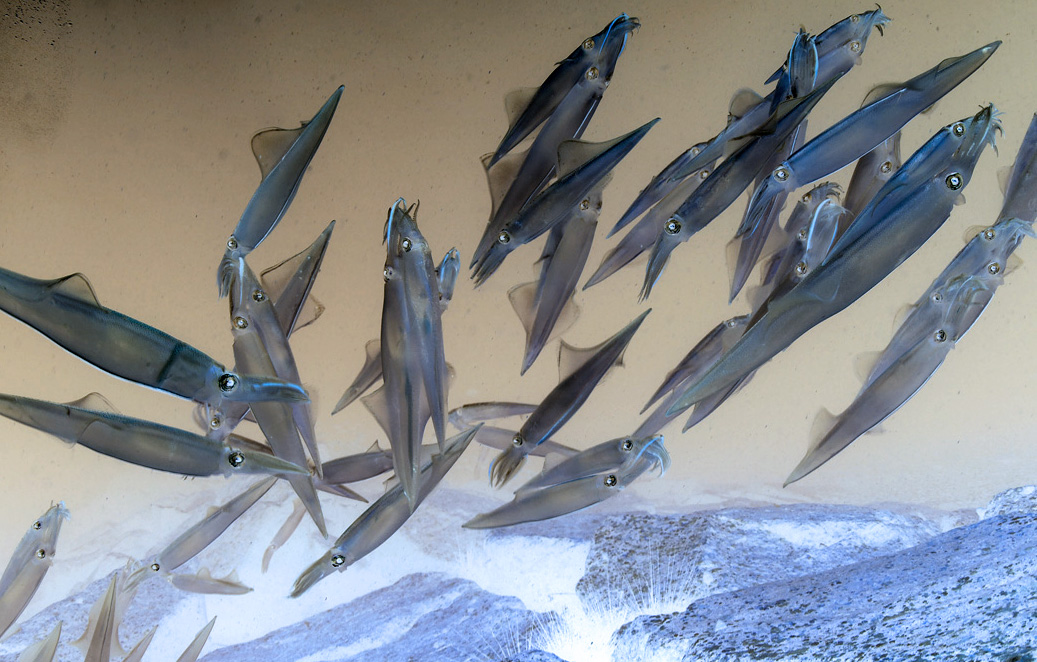
The nature of gene expression evolution is paradoxical: gene expression can exhibit both extreme lability and extreme conservation across time. This lability suggests that traits arising convergently may express the same functional genes. However, should we expect more similar patterns of gene expression among evolutionarily conserved traits? While natural selection is frequently invoked to explain how taxa facing similar biotic or abiotic pressures may arrive at similar phenotypic solutions, the extent to which convergent molecular processes drive phenotypic convergence remains unclear. My research seeks to understand if the number of possible ‘molecular solutions’ for a favored trait phenotype is as limited as the number of phenotypic solutions. Using next-generation sequencing to generate transcriptomes (sets of expressed genes), I compare the genetic signatures for complex phenotypes hypothesized to have evolved multiple times. Using comparisons of entire gene-expression profiles, my work addresses whether the pressure of natural selection influences genomic resourcefulness and causes the independent deployment of similar genetic pathways.
遺伝子発現の本性は逆説である。例えば、進化の間には非常に速く変える遺伝子発現もあれば、非常に安定な遺伝子発現もある。そんな本性のため、同じような遺伝子を発現することによって同じような特徴が収斂進化するかもしれない。しかし、進化的に保存された特徴の中では、収斂進化された特徴より同じような遺伝子発現のパターンだろうか。自然選択説は、同じような圧力を対処している生物が同じような表現型を進化された理由の説明に発動されているが、 遺伝子に収斂の変化するがどれだけ収斂的な表現型に影響を与えるのかは知られていない。イルミナというDNAシークエンシングの方法を用い、全部の発現された遺伝子のシクエンスを生じされて、収斂進化された特徴の遺伝子的な根拠が比べられる。全部の発現された遺伝子を比べることでこの研究は、自然選択が同じような構造遺伝子や酵素などを配備させるかどうか調べている。
Symbiosis
Jane Helf
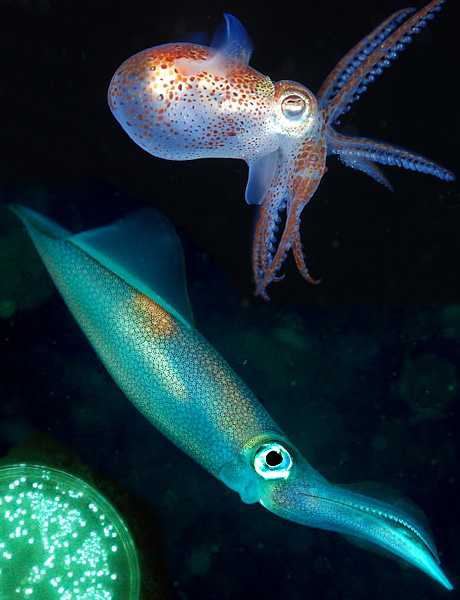
Convergent forms of bioluminescence have originated often across diverse forms of life, providing an excellent system for investigating convergent evolution. Within cephalopods, a form of bioluminescence reliant on a luminous symbiotic bacterium has evolved multiple times. Using target species Euprymna and Uroteuthis in a comparative transcriptomic approach, my work investigates if the expression profiles for genes required for the specialized organ housing these bacteria are as similar as the profiles between organs that share an evolutionary history (eyes, brain, etc.). Results of this work have important consequences for our understanding of gene expression evolution, the molecular signatures of both homologous and convergent traits, and the evolution of animal-bacteria symbiosis.
複数の生物に収斂する方法で発光しているのが観察されている。そのために、発光生物の現象は収斂進化の研究によく向いている。 頭足類の中で、共生の発光細菌と関係が一度ならず進化したらしい。 「 Euprymna 」というダンゴイカと 「 Uroteuthis 」というケンサキイカの遺伝子発現に比べることによって、この研究は、 発光細菌が入っている器官の中に発現された遺伝子のほうが相同器官の中に発現された遺伝子より違うかどうか知りたい。結果は遺伝子発現の進化し方を、進化的に保存された特徴と収斂進化しされた特徴の遺伝子的な根拠を、共生細菌の関係の進化について知らせるだろう。
Macroevolution
Joshua Insanus
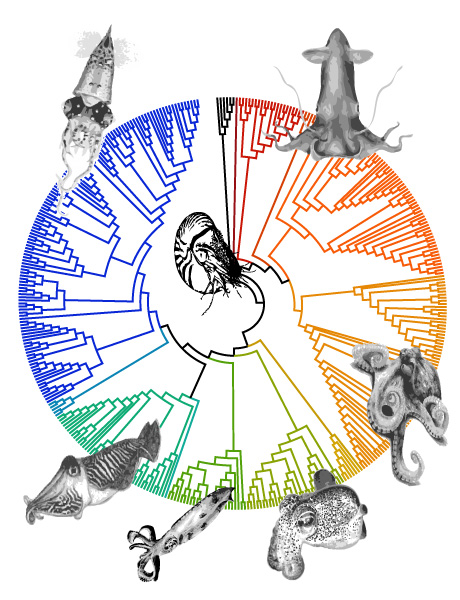
Occupying nearly every marine habitat, cephalopod molluscs are a diverse and ancient class whose sophisticated behavior, crypsis and communication are unrivaled among invertebrates. Formerly the dominant large predators of paleozoic seas, the success of this group has produced clades of stunning morphological varieties. Ongoing work investigates the relationships among these groups, timing of divergences, and the relationship between divergence rates and key genomic and morphological features.
頭足類は、ほとんどの海洋の住環境で見つかり、古くて多様な綱である。 無脊椎動物の中で、頭足類は利口な行動や隠蔽色や通信の能力という点から無比である。 古生代の海に頭足類は支配的な捕食者だったと考えられている。そんな成功のため、 多くの素晴らしい種類や表現型が生み出された。 私の論文は種類間の関係を、開度年代測定も、開度年代とあるゲノムの特徴との関係も調べている。

Curriculum Vitae

2004

  • B.S., Evolution & Ecology
    University of California, Davis

2014

  • Ph.D., Ecology, Evolution & Marine Biology
    University of California, Santa Barbara

2013

  • Dissertation Continuting Fellowship
    UCSB

2012

  • Charles A. Storke Graduate Fellowship
    UCSB
  • Ellen Schamberg Burley Graduate Scholarship
    UCSB
  • Doctoral Dissertation Improvement Grant
    National Science Foundation

2010

  • Lerner Gray Award
    American Museum of Natural History
  • Systematics Research Grant
    Linnean Society of London
  • Statistical Genetics Scholarship
    University of Washington

2009

  • Exploration Fund Research Grant
    Explorer’s Club
  • Summer Institute Fellowship
    National Science Foundation & Japan Society for Promotion of Science
  • Graduate Research Fellowship
    National Science Foundation

2008

  • Academic Grant
    Conchologists of America
  • Carriker Student Research Award
    American Malacological Society
  • Worster Award for Undergraduate Mentoring
    University of California Santa Barbara
  • Graduate Student Travel Fellowship
    Society for Integrative Biology

2007

  • Friday Harbor Laboratories Scholarship
    University of Washington

2003

  • Evolution & Ecology Academic Citation
    University of California, Davis

2002

  • President’s Undergraduate Fellowship
    University of California, Davis
  • MS Pankey, V Minin, GC Imholte, M Suchard, TH Oakley. Parallel transcriptomic signatures underlie convergent evolution of cephalopod bioluminescent organs. In prep.
  • FE Anderson, A Bergman , SH Cheng, MS Pankey, T Valinassab. 2014. Lights out: the evolution of bacterial bioluminescence in Loliginidae. Hydrobiologia 725(1): 189-203
  • SM Peyer, MS Pankey, TH Oakley, and MJ McFall-Ngai. 2014. Eye-specification genes in the bacterial light organ of the bobtail squid Euprymna scolopes, and their expression in response to symbiont cues. Mechanisms of development 131: 111-126
  • M Myers, MS Pankey, JP Wares. 2013. Genealogical approaches to the temporal origins of the Central American Gap. International Journal of Tropical Biology and Conservation Vol. 61 (1): 75-88
  • MS Pankey, AR Lindgren, FG Hochberg, TH Oakley. 2012. A multi-gene phylogeny of Cephalopoda supports convergent morphological evolution in association with multiple habitat shifts in the marine environment. BMC Evolutionary Biology 12:129
  • D Ramirez, DI Speiser, MS Pankey, TH Oakley. 2011. Understanding the dermal light sense in the context of integrative photoreceptor cell biology. Visual Neuroscience 28, 265-279.
  • MS Pankey, H Sunada, T Horikoshi, M Sakakibara. 2010. Cyclic nucleotide-gated channels are involved in phototransduction of dermal photoreceptors in Lymnaea stagnalisJournal of Comparative Physiology B 180(8), 1205-11.
  • AS Rivera, MS Pankey,  DC Plachetzki, C Villacorta, AE Syme, JM Serb, AR Omilian, TH Oakley. 2010. Gene duplication and the origins of morphological complexity in pancrustacean eyes, a genomic approach. BMC Evolutionary Biology 10, 123.
  • MS Pankey and TH Oakley. 2011. “Evolution of animal eyes”. In: Grzimek’s Animal Life Encyclopedia: Evolution. M. Hutchins, Ed. Gale Cenage Learning, Detroit.
  • JP Wares, MS Pankey, F Pitombo, L Gomez-Daglio, Y Achituv. 2009. A ‘shallow phylogeny’ of shallow barnacles (Chthamalus). PLoS ONE 4(5): e5567.
  • TH Oakley and MS Pankey. 2008. Opening the Black Box: The Genetic and Biochemical Basis of Eye Evolution. Evolution: Education and Outreach 4(1) 390-402.
  • MS Pankey and JP Wares. 2008. Overdominant maintenance of diversity in the sea star Pisaster ochraceous. Journal of Evolutionary Biology 22(1) 80-87.
  • CDG Harley, MS Pankey, JP Wares, MJ Wonham, RK Grosberg. 2006. Color polymorphism and genetic structure in the sea star Pisaster ochraceus. Biological Bulletin 211 (3): 248-262.

Contact

  • sabrina.pankey (at) lifesci.ucsb.edu
  • Ecology Evolution & Marine Biology
    University of California
    Santa Barbara CA 93106